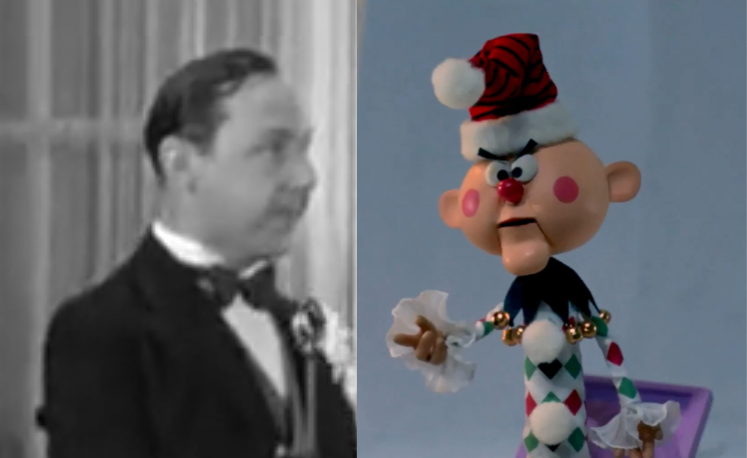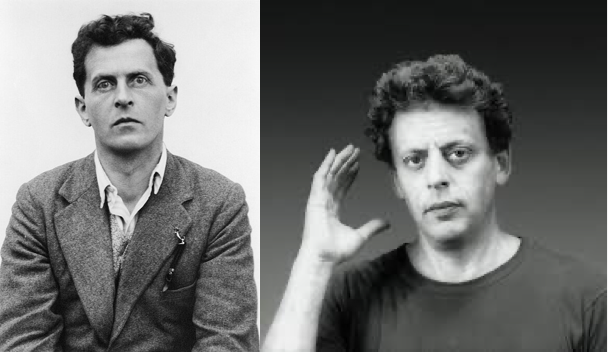
I wonder what Wittgenstein (left) would have thought of “separated at birth” Phillip Glass (right). Wittgenstein was from a very musical family, his brother Paul was a celebrated pianist who lost his right arm in WW I, but who went on to commission and perform one-handed pieces from some of the leading composers of his time.
This intrepid attitude is remarkable in light of the fact that there were three Wittgenstein brothers who committed suicide: Hans, Rudolph and Kurt. Ludwig lived an itinerant minimalist life, and although he only wrote one 75 page book, “Tractatus Logico-Philosophicus”, and some notes, he is considered one of the pre-eminent philosophers of modern times.
“Tracticus” is minimalist in that it is “written in an austere and succinct literary style, containing almost no arguments as such, but consists of 525 declarative statements, which are hierarchically numbered.” (Wikipedia). It’s notoriously difficult to understand. Here is a summation of the declarative statements:
- The world is everything that is the case.
- What is the case, the fact, is the existence of atomic facts.
- The logical picture of the facts is the thought.
- The thought is the significant proposition.
- Propositions are truth-functions of elementary propositions.
- This is the general form of proposition.
- Whereof one cannot speak, thereof one must be silent.
Got it? Facts –> picture of facts –> thought –> significant proposition –> elementary propositions. He believes there are realities that cannot be captured by language. I’m struggling to think of whether Wittgenstein considered language to be an abstraction – in the systems sense, the representation of something minus non-essential elements. I don’t think so because those realities he thinks are beyond language are not likely to be non-essential. He thinks about language as a code that enforces certain attitudes or beliefs, and states that the meaning of words is dependent upon contextual clues and “landmarks”.
To me that brings up the question of what are the realities that are beyond language? Is that what Phillip Glass is aiming for with his repetitive, rhythmic compositions? Is a Phillip Glass piece an abstracted Mahler? Is it Buddhist chanting (he was influenced by Buddhists)?
One can think of music as having a language of notes. I would say there are musical experiences that cannot be described, or are only poorly described, by words. Can words be represented by music? I don’t mean emotions, I mean whatever happens when you read.
Let’s say that language and music are limited in their ability to accurately describe “elementary propositions”, or even “atomic facts”. How do we then “know” anything? If it’s undescribable, unrepresentable. It’s pure experience, subjectivity. Or perhaps the need to describe is misguided. I have raised more questions than I have answered. I have violated Wittgenstein’s last precept: “Whereof one cannot speak, thereof one must be silent!”